
The Technical Framework: Equality Criteria Analysis (ECA)
At Samaanathe International Foundation, we believe environmental security is a human right, urging fair climate action for all generations. The Technical Framework: Equality Criteria Analysis (ECA)
Rohann kumar K (From Study Resources and Team Analysis)
5/8/20242 min read


The Technical Framework: Equality Criteria Analysis (ECA)
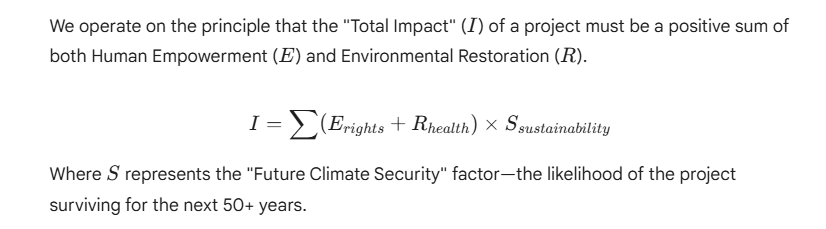
At Samaanathe, we don't guess—we measure. The Equality Criteria Analysis (ECA) is a multi-dimensional auditing tool used to ensure that human empowerment and environmental health are growing at a $1:1$ ratio.
1. The Core Equation of Balance
2. The Four Pillars of ECA
Our analysis evaluates every project against four distinct criteria. If a project fails even one, it is redesigned until balance is achieved.
I. Bio-Symmetry (The Environment’s Right)
Definition: The inherent right of an ecosystem to maintain its biodiversity.
Measurement: We track the "Return of the Native," monitoring the reappearance of indigenous flora and fauna as a result of our intervention.
II. Socio-Economic Parity (The Human’s Right)
Definition: The right of the "needful" to move from survival to stability.
Measurement: We use the Empowerment Index, measuring gains in local income, literacy, and health directly tied to climate action participation.
III. Carbon Integrity (The Value)
Definition: The accuracy of the carbon captured.
Measurement: Using satellite imagery and soil-carbon testing to provide verifiable data for our Carbon Credit Hub. We ensure the carbon isn't just "stored" but is part of a living, growing system.
IV. Intergenerational Equity (The Future’s Right)
Definition: Ensuring that today’s carbon credit sales do not "steal" the resources needed by future generations.
Measurement: A "Present-to-Future" impact assessment that calculates the resource availability for the next two generations.
3. The Implementation Flow
How we move a community from "Vulnerable" to "Responsible":
Baseline Audit: We measure the current "Inequality Gap" between the local people and their environment.
Strategic Empowerment: We provide the specific "Missing Links"—be it clean water, seeds, or digital literacy.
The Responsibility Shift: The community is trained to manage local "Carbon Sinks." This is where the Needful becomes the Accountable.
Continuous Monitoring: Our ECA experts perform quarterly checks to ensure the balance is maintained and the carbon is being sequestered effectively.
4. Why This Framework is Unique
Most environmental models are Top-Down (Corporations dictate terms). The Samaanathe ECA is Bottom-Up.
By making the "needful" the primary data-collectors and beneficiaries, we create a high-integrity data stream. This makes our Carbon Credits more valuable in the international market because they represent both Environmental Success and Human Justice.
Connect
Join us in caring for our shared earth.
Phone
contact@samaanathe.org
+91-9513-369-356
© 2025. All rights reserved.
Postal Address:
Samaanathe International Foundation
BHIVE Workspace MG Road (Near Trinity Metro Station)
Mahalakshmi Chambers, 29, Mahatma Gandhi Rd, next to Trinity
Metro Station, , Bengaluru, Karnataka 560001